




- Published on: 2026-10-14 10:13:17
Investor Compensation Fund Explained: Your 2026 Guide

Your broker can fail even when your investment decisions are sound, but compensation won’t rescue a portfolio from ordinary market losses. An investor compensation fund explained in plain terms starts with that distinction: these schemes may respond when a firm fails and eligible assets can’t be returned, not when an investment falls in value.
Before depositing money, find out whether your investments or cash could qualify for protection and what would happen if the firm failed. The answer depends on the country, the firm’s legal entity, the account and assets involved, and the scheme’s rules. Similar names can also refer to very different levels of coverage.
This guide explains what investor compensation schemes may cover, where their limits lie, and how eligibility and claims work. It also compares compensation with deposit protection and market risk, and gives you practical checks to make before opening a trading account. If you’re comparing TradingPRO’s Rookie, Micro, Pro, or Scalp accounts, start by identifying the legal entity in your account documents, then assess relevant protections separately. Make your decision based on the rules, not assumptions.
Key Takeaways
- An investor compensation fund explained clearly helps distinguish eligible claims after a firm failure from losses caused by investment performance.
- A claim may involve a firm-failure process, an administrator’s review, and an assessment by the scheme. Compensation isn’t automatic.
- Identify the account’s legal entity, applicable scheme, eligibility rules, limits, and claim process before relying on possible protection.
- Compare account terms and trading risks alongside any potential compensation. Protection is one part of an informed decision.
- A broker’s brand name alone may not tell you which legal entity holds your account.
What is an investor compensation fund, and what problem does it solve?
An investor compensation fund is a scheme that may compensate eligible clients if a covered investment firm fails and can’t return assets it held for them. It addresses a specific risk: clients may be unable to recover eligible cash or investments because of the firm’s failure. It doesn’t guarantee repayment. The firm, client, account, and claim must meet the scheme’s rules, which vary by jurisdiction.
That distinction is central to having an investor compensation fund explained accurately. These schemes aren’t a safety net for every financial setback. If a share, fund, or other investment loses market value, that loss is part of investment risk, not evidence that the broker has failed. A poor trading decision or an allegation of fraud also doesn’t automatically qualify for compensation. Separate complaint, legal, or regulatory processes may apply.
What event can trigger investor compensation?
A possible trigger is a covered firm’s failure to return eligible client assets. The relevant scheme may first need to establish that the firm meets its definition of failure and that assets are missing or can’t be returned. The trigger and claim-handling process depend on local rules. For an overview of one US example, see the Securities Investor Protection Corporation (SIPC).
Hypothetical example: An investment firm enters insolvency, and an administrator finds that some client assets recorded in its accounts can’t be returned. Eligible clients might be able to submit claims for assessment under the applicable scheme. The administrator and scheme would review the facts and rules. The firm’s closure alone wouldn’t guarantee that a claim is accepted or paid.
How is a compensation fund different from a deposit guarantee?
Investment-firm compensation and bank deposit protection address different types of failure. An investor compensation scheme may cover eligible clients when an investment firm can’t return covered assets. A deposit guarantee may protect eligible deposits held with a covered bank if that bank fails. Each has its own responsible authority, covered firms, products, eligibility tests, and limits.
Don’t assume the word “cash” settles which protection applies. Cash in an investment account and money deposited with a bank may fall under different rules, depending on the account structure and firm involved. Some products or clients may be excluded, and a scheme’s limit may cap any payment. Check the rules for the country and legal entity connected to the account.
- Investment firm: Check whether the scheme addresses eligible client assets that can’t be returned after a covered failure.
- Bank deposit: Check whether the institution and deposit qualify under local deposit-protection rules.
- Either case: Confirm the claims process and limits. Neither scheme protects every balance or financial product.
Find out what event a scheme covers before relying on it. This helps separate firm-failure protection from the market risks that remain part of trading and investing.
How investor compensation schemes work when a financial firm fails
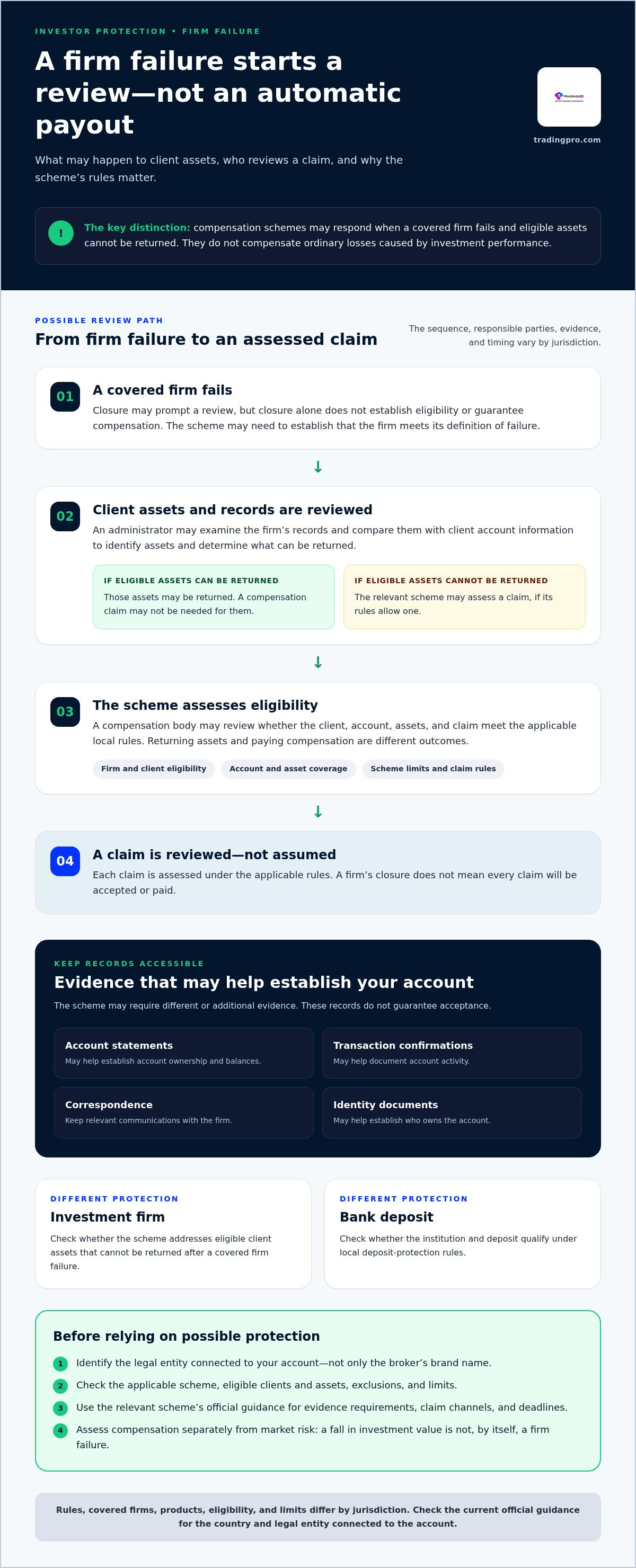
A firm’s closure starts an assessment; it doesn’t automatically approve every client claim. The first priority may be to establish what happened to client assets and whether they can be returned. If assets are missing or inaccessible, the relevant compensation body may assess eligible claims under local rules. The sequence, responsible authorities, evidence requirements, and timing differ between jurisdictions.
A firm failure can prompt a review, but payment depends on the facts and scheme criteria. Returning assets and paying compensation are different outcomes. If an administrator can identify and return a client’s eligible assets, a compensation claim may not be needed for those assets. A scheme may be considered if eligible assets can’t be returned and its rules allow a claim.
What happens after a covered firm failure?
The process can involve several parties. A regulator or other authority may take steps under local law; an administrator may review the firm’s records; and a compensation body may decide whether claims qualify. Their roles vary. For UK readers, the Financial Services Compensation Scheme (FSCS) provides official information about its protection and claims process. For other jurisdictions, use the relevant scheme’s primary guidance.
Records may be checked against client account information to identify who held eligible assets and what can be returned. The review may uncover differences between a client’s records and the firm’s books. Each claim is assessed under applicable rules, so a firm ceasing operations alone doesn’t establish eligibility or guarantee compensation.
What information may a claimant need?
Keep useful records accessible before a problem arises. Account statements, transaction confirmations, correspondence, and identity documents may help establish account ownership, balances, and activity. They don’t guarantee acceptance, and a scheme may require different or additional evidence. Follow instructions from the relevant authority or compensation body. A general checklist isn’t a substitute for its formal requirements.
Claim forms, submission channels, deadlines, and review procedures depend on the jurisdiction. Check the scheme’s current official guidance for required documents and dates. Don’t assume rules in one country apply elsewhere. If information is missing or inconsistent, preserve the records you have and follow the body’s process for explaining or correcting discrepancies.
This overview describes the usual logic, but it isn’t a universal legal process:
- Failure is identified. The relevant authority or legal process determines what action applies to the firm.
- Records and assets are reviewed. An administrator or appointed party may reconcile firm records and client information to establish what can be returned.
- Claims are invited or assessed. The relevant body applies local rules to determine who may claim and what evidence is required.
- An outcome is reached. Assets may be returned, a claim may qualify for compensation, or it may be declined. The outcome depends on the evidence and scheme rules.
Before opening an account, include the legal entity and account terms in your checks. You can explore account registration while assessing any protection separately under the relevant scheme’s rules.
What investor compensation covers, and what it does not
Coverage depends on more than the amount shown in an account. A scheme’s rules may consider whether the firm and service qualify, who the client is, what asset is involved, and how the account is held. That’s why “investor compensation fund explained” shouldn’t be reduced to one universal limit or a promise that every balance is protected.
Use this comparison as a starting point, not a substitute for the rules in the relevant country:
| Situation | How compensation may apply |
|---|---|
| A covered firm fails and eligible client assets cannot be returned | A compensation scheme may assess a claim if the investor, service, and assets meet its rules. |
| An investment falls in value | A market decline is generally an investment loss, not a firm-failure claim. |
| A trade performs poorly | A scheme isn’t a guarantee against unsuccessful trading or an investment decision that loses money. |
| A balance exceeds a scheme’s applicable limit | Any compensation may be limited by the scheme’s rules; the cap is not necessarily the value of the investor’s full portfolio. |
Distinguish a portfolio’s value from a compensation limit. A portfolio may include assets worth more than the maximum a scheme may pay, and that maximum may apply only to qualifying claims under defined conditions. How limits are calculated, including the treatment of account types or multiple accounts, varies. Check the scheme’s current official guidance before relying on a figure.
Which investors and assets may qualify?
Schemes define eligible claimant categories and the investment services or assets they cover. Eligibility may differ according to client classification, product type, account structure, and the legal entity providing the service. For example, professional status or whether an account is held jointly or individually could matter under local rules. Don’t assume one country’s criteria apply to another.
Verify each detail against the scheme’s primary guidance. A familiar broker brand alone doesn’t establish which entity holds the account or whether a particular product qualifies.
Which losses are generally outside a compensation scheme?
Ordinary market declines and unsuccessful trades are investment risks, not losses a compensation scheme is designed to reverse. If an asset price falls while the firm remains able to meet its obligations, that change in value doesn’t by itself create a compensation claim.
Other disputes may involve different rules and processes. Don’t assume that a disagreement about advice, an allegation of fraud, or a particular asset automatically qualifies or is excluded. Confirm how the relevant scheme treats the specific issue, claimant, and account arrangement.
Before funding an account, match the scheme’s eligibility rules to the legal entity, client category, and assets involved. This gives you a clearer view of what protection may address and what remains part of investment risk.
Check if an investor compensation scheme applies to you
To check whether a scheme could apply, start with the account’s legal entity, not just the name on the platform. The entity in your account agreement helps identify the country’s rules and which regulator or compensation body may be relevant. Then verify the scheme’s eligibility criteria, limits, and claims process using primary sources. Use this checklist to replace assumptions with specific checks before funding an account.
- Identify the account entity. Find the full legal name in your account-opening documents or legal disclosures.
- Find the regulator. Search the regulator’s official register and match the entity’s name and details.
- Identify the scheme. Use regulator information to locate the relevant compensation scheme, if one applies.
- Review eligibility. Check claimant categories, covered services, and how the scheme treats your assets and account structure.
- Confirm the limits. Read how any cap is calculated, including which accounts or assets it applies to.
- Understand the claims process. Check who handles claims, what evidence is required, and any deadlines.
Quotable takeaway: Identify the account entity, regulator, scheme, eligibility rules, limits, and claims process. These checks clarify potential coverage but don’t guarantee compensation.
How do you identify the legal entity and applicable jurisdiction?
Read the account agreement and legal disclosures for the contracting entity’s full name and jurisdiction. A broker brand may operate through more than one company, and regional entities can have different regulators and protection arrangements. TradingPRO operates through multiple regional entities, including Trading Pro Ltd in Mauritius and Trading Pro (PTY) LTD in South Africa. Check the entity-specific terms rather than inferring coverage from the brand name.
How should you verify scheme rules and claim limits?
Use the regulator’s official register to confirm the entity and its regulatory status, then consult the regulator’s or scheme’s own website for protection rules. Look for the exact eligibility conditions, covered services, treatment of the asset and account, compensation limits, and claim deadlines. Rules can change, so check current primary guidance and note its date before relying on details. Don’t carry a limit across countries or assume it applies to every account.
Keep the account documents and relevant official guidance together. If the legal entity, regulator, or scheme named in the documents doesn’t match what you find in official sources, pause and resolve the discrepancy before proceeding. These checks help you understand the framework; they don’t establish that a future claim would qualify.
Once you’ve reviewed the account terms and understand the applicable protections, you can start your TradingPRO account registration.
Make investor protection part of a smarter account-opening decision
Understanding investor compensation rules is one part of due diligence, not a substitute for managing trading risk. A scheme may address eligible losses linked to a covered firm failure, but it doesn’t shield you from changes in market value, unsuccessful trades, or risks described in your account terms. Use your research to make a considered decision, not to assume your funds are guaranteed.
What should you understand before funding a trading account?
Start with the agreement. Identify the legal entity you’ll contract with, read the account terms, and review the risk disclosures before depositing funds. Make sure you understand how the account works, what charges or conditions apply, and what risks could affect your balance. If a product involves leverage, understand how it can magnify losses as well as market exposure. Compensation for firm failure doesn’t cover trading losses.
Then compare the account’s stated features with your experience, goals, and tolerance for loss. Don’t choose based on a protection limit alone. Account terms and risks matter just as much, and no account choice can guarantee an investment outcome.
- Entity: Match the legal name in the agreement to the regulator and scheme information you’ve researched.
- Terms: Read the account conditions and understand how funds and transactions are handled.
- Risk: Consider what you could afford to lose and whether the product’s risks suit your experience.
- Protection: Treat potential compensation as conditional and separate from market performance and trading risk.
How can a beginner take a measured next step?
Complete your scheme research before deciding whether to open an account. Confirm the entity, review the relevant official rules, and make sure you understand the account terms. If a point remains unclear, consult the applicable primary guidance rather than assuming a scheme applies. Understanding both protection and risk is a stronger starting point than acting on incomplete information.
TradingPRO offers a Rookie Account alongside its other account options. Review the terms and decide whether the account aligns with your needs. The fact that an account is available doesn’t establish that it is covered by a particular compensation scheme. A useful question to ask is: which entity, rules, and risks apply to the account I’m considering?
When you’ve completed your checks and are ready to proceed, create a TradingPRO account.
Move forward with clarity and confidence
An investor compensation fund explained should lead to a practical habit: include protection in your account research, but don’t mistake it for a substitute for understanding trading risk. Before committing funds, review the terms, assess whether the account fits your experience, and consider your own goals and tolerance for loss.
Take time to reach a decision based on the account’s actual terms, not assumptions about what a compensation scheme might cover. A measured choice starts with clear expectations and an understanding of the risks involved.
When you’re ready to explore an account, create a TradingPRO account. Review the terms and make your next move with a clear understanding of the decision.
Frequently Asked Questions
What is an investor compensation fund?
An investor compensation fund explained simply is a jurisdiction-specific mechanism that may compensate eligible clients after a covered financial firm fails. It isn’t general insurance, and approval or full recovery isn’t guaranteed. For example, a customer may need to distinguish the firm named on an old statement from the entity listed in the account agreement. Coverage depends on current scheme rules, including qualifying services, claimant eligibility, and applicable limits.
Does an investor compensation fund protect me if my investments lose value?
No. An ordinary fall in an investment’s value isn’t the same as a covered firm failure. If a market price drops while your firm continues operating, a compensation scheme generally isn’t designed to reimburse that loss or guarantee a return. An unsuccessful trade is also a trading risk. Check the applicable scheme’s official rules for exact coverage, and assess investment performance separately from firm-failure protection.
Who is eligible for investor compensation?
Eligibility depends on the scheme and your specific relationship with the firm. Rules may distinguish individual clients from other client categories, or treat services, products, and account arrangements differently. Review the client classification and contracting entity shown in your account documents, then compare them with the scheme’s current eligibility guidance. Don’t assume that being a brokerage customer, or seeing a balance on a platform, means you qualify.
How much compensation can an investor receive?
There isn’t one universal payout amount. Limits and calculation methods depend on the country, scheme, claimant, and qualifying circumstances, and they may not correspond to the total value shown in a portfolio. Before relying on a published figure, check the scheme’s official source for its effective date, who the limit applies to, and which assets or accounts it covers. Treat older articles and summaries as prompts to verify, not final authority.
Are shares protected if a broker goes bust?
It depends on the custody arrangement, the firm’s failure, and local rules. Start by reviewing account statements and custody terms to understand how the assets are held and which legal entity is responsible. If records show a discrepancy between expected and accounted-for assets, follow the administrator’s or scheme’s official process. A broker’s failure doesn’t mean every share can’t be returned or that every shortfall qualifies for compensation.
How do I find out whether my broker is covered by an investor compensation scheme?
Find the full contracting entity name in your account agreement, then search that exact name in the relevant regulator’s official register. Use the register and regulator guidance to locate any applicable scheme, and check whether its rules cover your service and client category. A broker brand may serve customers through different regional entities, so don’t assume results for one company apply to another.
Is investor compensation the same as deposit protection?
No. Investor compensation and deposit protection relate to different financial arrangements and may involve different authorities, products, and eligibility tests. Don’t treat cash displayed in a brokerage account as equivalent to a bank deposit without checking how the account is structured. Identify the entity that holds or provides the account, then consult the relevant regulator’s and scheme’s official guidance to understand which rules apply.


