



- Published on: 2026-11-03 09:04:00
How to Use Moving Averages in Trading: A Complete Step-by-Step Guide
Understanding the Foundation of Trend Trading
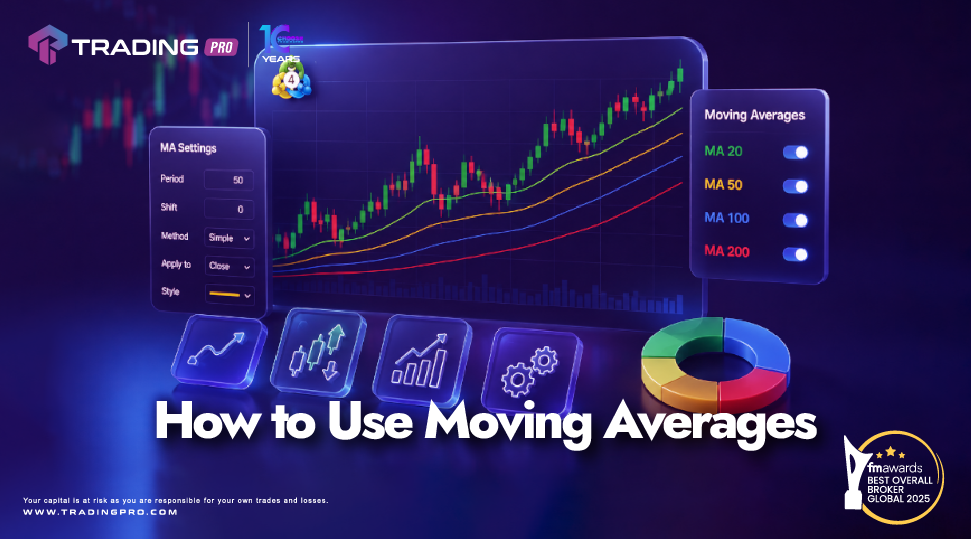
Moving Averages (MAs) are among the most versatile and widely utilized technical indicators in financial trading. By continually updating the average price of an asset over a specified number of periods, moving averages smooth out short-term price fluctuations ("market noise") to reveal the underlying direction of a market.
Whether you are day trading major forex pairs, indices, or commodities, understanding how to interpret and apply moving averages directly improves your market timing. Paired with the institutional-grade execution speeds and tight spreads provided by TradingPRO, moving averages provide a solid framework for building quantitative entry and exit strategies.
SMA vs. EMA: Choosing the Right Moving Average
Before building a trading strategy, you must choose between the two primary types of moving averages available on MetaTrader 4 and MetaTrader 5:
| Feature | Simple Moving Average (SMA) | Exponential Moving Average (EMA) |
| Calculation | Calculates the arithmentic mean of price over a set period equally. | Assigns greater weight and importance to recent price data. |
| Reaction Speed | Slower to react to sudden market price changes (lagging). | Faster reaction to recent volatility and sharp reversals. |
| Best used for | Long-term macro trend identification and major support levels. | Short-term scalping, day trading, and quick trend entries. |
| Popular entries | 50 SMA, 100 SMA, 200 SMA | 9 EMA, 12 EMA, 21 EMA, 26 EMA |
3 Core Strategies for Trading with Moving Averages
1. Trend Direction Filter
The simplest way to use a moving average is as an absolute market filter.
Bullish Rules: If price candles trade above a long-term moving average (e.g., 200 SMA), the trend is deemed bullish. Traders focus exclusively on looking for Buy setups.
Bearish Rules: If price candles trade below the 200 SMA, the trend is deemed bearish. Traders focus exclusively on looking for Sell opportunities.
2. Dynamic Support and Resistance
Unlike static horizontal support and resistance lines, moving averages shift continuously along with price action, creating dynamic barriers.
- During an uptrend, prices frequently pull back to test a key line—such as the 20 EMA or 50 SMA—before bouncing upward.
- Traders use these price retests to enter trades at more favorable prices in the direction of the trend.
3. Moving Average Crossover System
A crossover strategy involves combining a fast moving average (short period) with a slow moving average (long period) to capture momentum shifts:
- Golden Cross (Bullish Signal): Occurs when a faster moving average (e.g., 50 SMA) crosses above a slower moving average (e.g., 200 SMA), signaling the start of a strong uptrend.
- Death Cross (Bearish Signal): Occurs when a faster moving average crosses below a slower moving average, signaling an impending downtrend.
How to Add Moving Averages on MT4/MT5
Setting up moving averages on MetaTrader desktop or mobile terminals takes just a few clicks.
Step 1: Open Your Active Chart: Select your financial instrument.
Launch your MT4 or MT5 terminal connected to your TradingPRO account. Drag your target currency pair or index from the Market Watch onto the main workspace.
Step 2: Add Indicator from Menu: Access technical tools.
Click on Insert in the top navigation bar, select Indicators > Trend, and click Moving Average.
Step 3: Configure Parameters: Set period and calculation method.
In the settings box:
- Period: Enter your desired number of candles (e.g., 20 or 200).
- MA Method: Choose Simple for SMA or Exponential for EMA.
- Apply to: Select Close (default standard).
Step 4: Confirm and Apply: Format visual aesthetics.
Choose your preferred line color and stroke thickness to differentiate between multiple MAs on your chart, then click OK.
Frequently Asked Questions
Which moving average timeframe works best?
The ideal period depends on your trading style. Scalpers and day traders frequently prefer the 9 EMA and 21 EMA on 5-minute or 15-minute charts. Swing traders and position traders rely heavily on the 50 SMA and 200 SMA on 4-hour and Daily charts.
Do moving averages guarantee profitable entries?
No moving average can predict future prices with complete certainty because all moving averages are lagging indicators based on past data. To minimize false signals, always pair moving averages with price action patterns (candlesticks) and momentum indicators like RSI.
How do I practice moving average strategies without risking real capital?
You can test moving average crossovers and dynamic support strategies risk-free on a free TradingPRO demo account, equipped with real-time market data feeds and simulated funds.


