



- Published on: 2026-10-29 13:02:00
Fed Holds at 3.75%-4% With Two Hawkish Dissents: December Hike Odds Climb to 85%
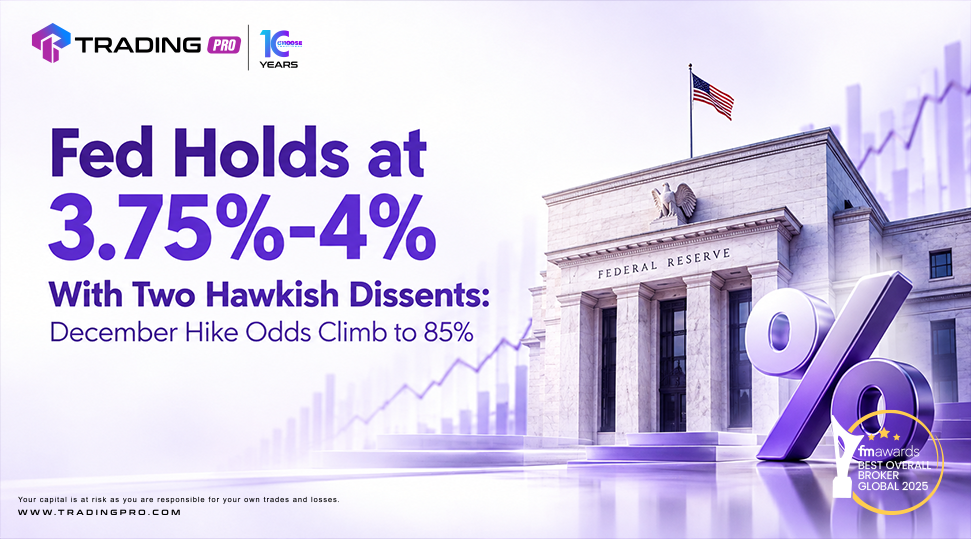
The Federal Reserve left interest rates unchanged at 3.75% to 4% on Wednesday 28 October, but two officials voted for a hike, and futures now price an 85% chance of an increase in December. The dollar edged lower, yields stayed high and stocks edged higher, so the pause did little to ease the tightening outlook.
Below, we cover the FOMC decision, how markets reacted and what traders may want to watch next.
Fed Holds Rates at 3.75% to 4%
The Federal Open Market Committee (FOMC) voted 10-2 to keep the federal funds rate in its current range, according to the Fed's statement. It was the first meeting since the quarter-point hike on 16 September, and the pause was widely expected. CNBC reported that markets had priced less than a 10% chance of a hike.
The tone stayed firm. The statement said inflation remains elevated and upgraded the Fed's view of the economy to "strong" from "solid", according to Reuters. It also said the accumulation of more information will help determine the policy stance, which keeps the door open to a hike without promising one.
Cook and Hammack Dissent for a Hike
The surprise was in the vote. Governor Lisa Cook and Cleveland Fed President Beth Hammack both preferred a quarter-point increase. Hammack is a consistently hawkish voice who also dissented in July, but CNN noted that Cook had never dissented on a policy decision before.
David Krakauer of Mercer Advisors told Reuters that Cook's dissent was the surprise, since many had expected Hammack and Logan to be the hawks. Reuters also noted that Cook is currently targeted by President Donald Trump for removal from the Fed. Either way, two dissents for a hike widen the hawkish camp ahead of December.
Warsh Gives Little Forward Guidance
Chair Kevin Warsh used the press conference to stress the strength of the economy and the commitment to bring inflation back to 2%. He also made clear he is not a fan of signalling the path ahead. "I don't believe in forward guidance, absent exigent circumstances, absent a crisis," he told reporters, as CNBC's live blog reported.
That left the December debate open. InvestingLive's recap said Warsh did little to challenge expectations of a hike.
Warsh also announced a change to the calendar. From 2027, one of the Fed's eight yearly meetings will focus only on broad strategy, with no rate decision or policy statement, which leaves seven rate-setting meetings a year.
Dollar Slips, Treasury Yields Stay High
The reaction was calm. The US dollar index fell about 0.2% on the day, according to Reuters and CNN.
Yields told a more interesting story. The two-year yield, the most sensitive to Fed policy, rose to about 4.78% right after the statement, then fell to around 4.71% as Warsh spoke. The 10-year yield ended the day near 5.02%, the Motley Fool reported. A 10-year yield above 5% keeps pressure on stocks and gold, while a softer front end suggests traders do not expect a faster pace of hikes.
Gold Slips as Long Yields Climb
Gold had a choppy session, and reports of its move on the day varied, from roughly flat to about half a percent lower, as long-dated yields climbed. CNN reported that futures dipped as much as 0.9% before recovering during the trading day.
The focus now shifts to Thursday's PCE inflation report and GDP data. Kitco noted that stronger growth or persistent inflation could reinforce December hike expectations and lift yields, which would be a headwind for gold. Softer data could do the opposite. Gold had already slipped after the hot September CPI report, so the metal remains sensitive to every rate headline.
Stocks Edge Higher
US stocks closed slightly higher. The S&P 500 rose 0.28% to 7,743.98, its third straight gain, according to CNBC. A hold that matched expectations removed one source of uncertainty, even though the hawkish tilt remains.
December Hike Odds Climb to 85%
The hold shifted attention straight to the next meeting in early December. According to CME FedWatch, the probability of a December hike rose to 85% from 78% a day earlier. The Fed's September projections had already signalled another increase before year end.
Analysts are divided on timing, not direction. DoubleLine's Jeffrey Gundlach said the Fed should be raising rates, according to CNBC. Karen Manna of Federated Hermes told Reuters that the hold has deferred the debate rather than settled it, with attention now on December and incoming data. Before the meeting, a string of Fed speakers had suggested they were comfortable with a slower pace of tightening, as CoinDesk reported.
What It Means for Inflation and Oil
The Fed's firm stance reflects what the data has been showing. September CPI rose 3.7%, driven by a 9.1% jump in gasoline, and oil rose again on Wednesday as Middle East tensions escalated, with crude still above $100 a barrel amid the Strait of Hormuz standoff.
That link matters. If oil stays high, headline inflation stays high, and the case for another hike strengthens. If diplomacy in the Gulf eases crude prices, some of the pressure on the Fed could fade.
Which Markets Are Most Exposed
- The US dollar: A hawkish Fed supports the dollar, although the hold itself pulled it slightly lower.
- Treasury yields: The 10-year yield is above 5%, and it is the benchmark for mortgages and other borrowing costs.
- Gold: It balances safe-haven demand against higher yields and a firm dollar.
- Stock indices: Rate hike expectations weigh on growth and technology shares, but the market has held up so far.
What to Watch Next
- PCE inflation and GDP on Thursday: The Fed's preferred inflation gauge could shift December odds quickly, and economists expect third-quarter GDP growth near 3.2% annualised.
- The ECB on Thursday and the Bank of Japan on Friday: Other central bank decisions can move the dollar against the euro and yen.
- US midterm elections on 3 November: Political risk and Fed independence could add volatility.
- The October jobs report on 6 November: A weak reading could soften hike expectations, while a strong one could reinforce them.
- The next FOMC decision on 9 December: It comes with new projections, so every data release before then matters.
- Fed speakers and Warsh: With little forward guidance, comments from officials will carry more weight.
- Oil and Hormuz headlines: Energy prices remain the main driver of the inflation outlook.
Because markets can move sharply around data and central bank news, many traders plan position sizes and exit levels ahead of time.
The Bottom Line
The Fed held rates at 3.75% to 4%, but this was not a dovish pause. Two dissents for a hike, a strong view of the economy and a chair who prefers not to signal the path all point to a December rate hike as the base case. The reaction so far has been measured, with the dollar slightly weaker, yields high and stocks slightly higher.
With inflation data, oil, central bank meetings and the midterm elections all ahead, the dollar, gold and major indices are likely to stay sensitive to every shift in rate expectations.
Trade the Next Move with TradingPRO
Ready to trade the markets that react to Fed decisions and inflation data? Register with TradingPRO today and access forex, gold, indices and more on our website. Follow the latest market updates on our socials.


