



- Published on: 2022-03-11 08:19:00
Altcoin Trading Guide 2022: How to Evaluate, Select, and Trade Beyond Bitcoin
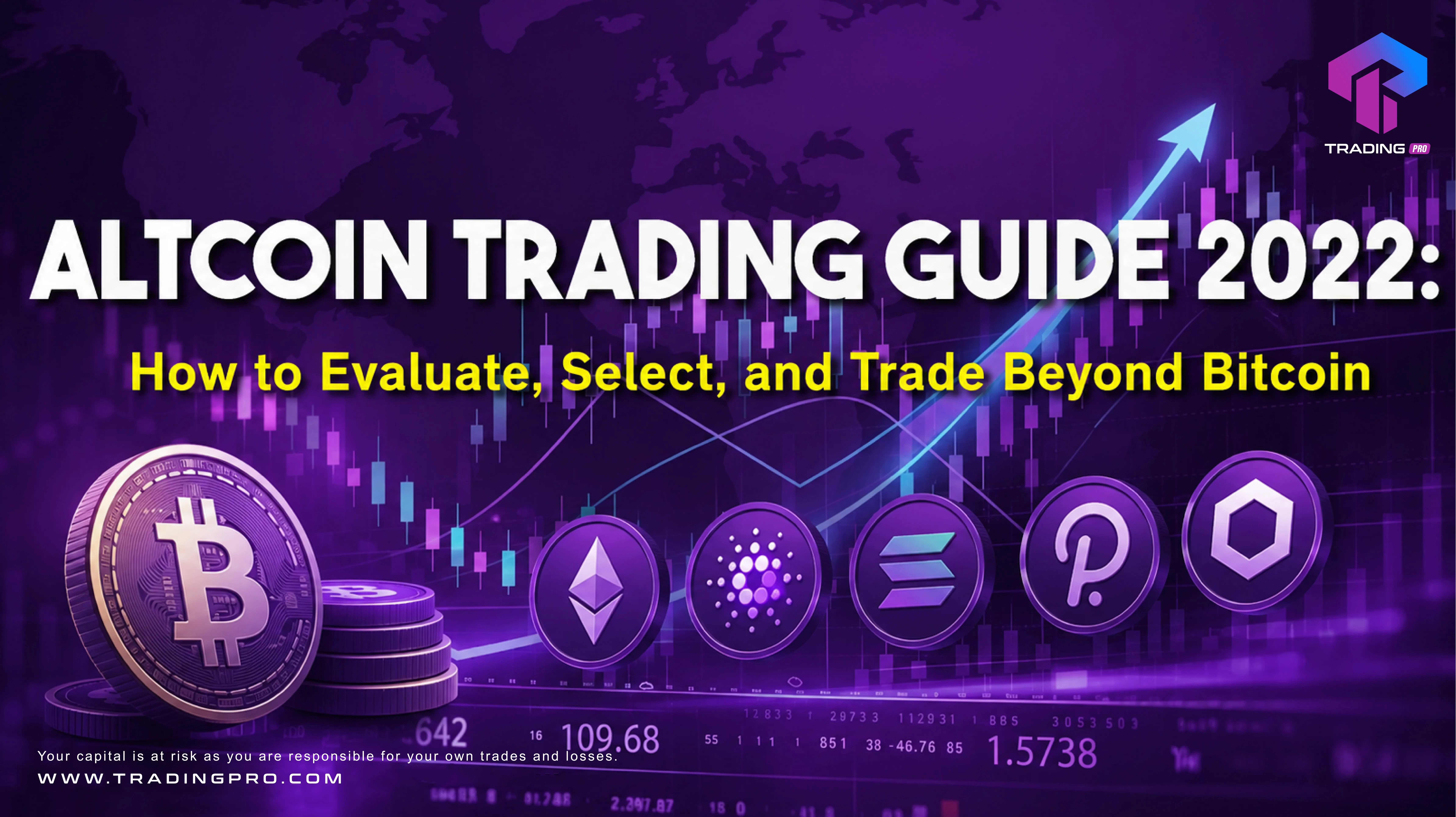
Bitcoin may be the gateway to cryptocurrency for most traders, but the broader altcoin market — encompassing thousands of alternative cryptocurrencies from Ethereum to smaller emerging projects — is where some of the most explosive (and most volatile) trading opportunities exist. In 2022, with over 18,000 cryptocurrencies in existence and combined altcoin market capitalization regularly exceeding $1 trillion, understanding how to evaluate and trade altcoins has become an essential skill for any serious crypto trader.
This guide is designed for traders who already have a basic understanding of cryptocurrency and Bitcoin, and want to expand their knowledge into the broader altcoin market. We will cover how to evaluate altcoin quality, understand market cycles, manage the unique risks of altcoin trading, and use TradingPRO to access this dynamic market with confidence.
What Exactly Is an Altcoin?
The term 'altcoin' refers to any cryptocurrency other than Bitcoin. This includes major projects like Ethereum, Solana, and Cardano, all the way down to thousands of smaller, less established tokens. Altcoins span an enormous range of use cases: smart contract platforms, decentralised finance protocols, gaming and metaverse tokens, privacy coins, oracle networks, and much more.
Not all altcoins are created equal. Some represent genuinely innovative technology solving real problems with strong development teams and growing adoption. Others are speculative ventures with little underlying value, designed primarily to capitalise on short-term hype cycles. Distinguishing between the two is the central skill of successful altcoin trading.
How to Evaluate an Altcoin Before Trading It
1. Market Capitalisation and Liquidity
Market cap (price multiplied by circulating supply) gives you a sense of an altcoin's relative size and stability. Large-cap altcoins (Ethereum, BNB, Solana) tend to be less volatile and more liquid, making them suitable for larger position sizes. Small-cap and micro-cap altcoins can offer outsized gains but come with proportionally higher volatility and liquidity risk — meaning it can be difficult to exit a position without significantly moving the price against yourself.
2. Tokenomics
Tokenomics refers to the economic design of a cryptocurrency: its total supply, circulating supply, emission schedule, and the utility that drives demand for the token. Key tokenomics factors to evaluate:
- Supply Schedule — is the total supply fixed (like Bitcoin's 21 million cap) or inflationary? High inflation rates can create persistent sell pressure that caps long-term price appreciation.
- Token Utility — what is the token actually used for? Governance, paying transaction fees, staking rewards, or accessing a specific service? Tokens with genuine utility tend to have more sustainable demand than those that exist purely for speculation.
- Distribution — what percentage of tokens are held by the founding team, early investors, and the public? Heavy concentration among insiders creates risk of large sell-offs (often called 'unlocks') that can crash the price.
- Vesting Schedules — many projects have token unlock schedules for team and investor allocations. Understanding upcoming unlock events is critical, as large unlocks frequently precede price declines due to increased sell pressure.
3. Development Activity and Team
Active, transparent development is one of the strongest signals of a project's long-term viability. Check the project's GitHub repository for commit frequency and developer activity. Research the founding team's track record, previous projects, and public credibility. Anonymous teams are not automatically a red flag in crypto (Bitcoin's creator remains anonymous), but they do increase the importance of other due diligence factors.
4. Use Case and Competitive Positioning
Ask yourself: what problem does this project actually solve, and how does it compare to competitors solving the same problem? A smart contract platform competing with Ethereum needs a genuinely compelling value proposition — faster transactions, lower fees, better developer tools — to capture meaningful market share. Projects with vague or redundant use cases relative to established competitors face a much higher bar for long-term success.
5. On-Chain and Social Metrics
- Active Addresses — a growing number of unique active wallet addresses interacting with a network is a positive sign of genuine adoption, distinct from pure speculative trading volume
- Total Value Locked (TVL) — for DeFi protocols specifically, TVL measures the total capital deposited into the protocol. Rising TVL generally indicates growing trust and usage.
- Social Sentiment and Community Engagement — while social hype alone is not a reliable basis for investment decisions, genuine, sustained community engagement (as opposed to bot-driven hype) can be a supporting signal of organic interest
Understanding Altcoin Season
'Altcoin season' refers to periods when altcoins, as a category, significantly outperform Bitcoin. This phenomenon follows a fairly consistent pattern across crypto market cycles:
- Phase 1: Bitcoin Leads — in the early stages of a bull market, capital flows predominantly into Bitcoin as the most trusted, liquid crypto asset. Bitcoin dominance (BTC's share of total crypto market cap) rises.
- Phase 2: Large-Cap Altcoins Follow — as confidence builds, capital begins rotating into established large-cap altcoins like Ethereum, which often outperforms Bitcoin in percentage terms during this phase.
- Phase 3: Altcoin Season — capital rotates further down the market cap spectrum into mid-cap and small-cap altcoins, often producing extraordinary percentage gains as speculative capital seeks higher returns. Bitcoin dominance falls sharply during this phase.
- Phase 4: Distribution and Correction — altcoin season typically ends abruptly, with smaller-cap tokens experiencing the sharpest corrections as speculative capital exits. This is historically the most dangerous phase for traders who entered late and oversized positions.
Monitoring Bitcoin Dominance (BTC.D) on a chart is one of the simplest and most effective ways to track where the market is in this cycle. A declining BTC.D trend alongside rising total crypto market cap is the classic signature of an emerging altcoin season.
Building a Balanced Altcoin Trading Portfolio
- Core-Satellite Structure — anchor the majority of your portfolio in established, large-cap assets (Bitcoin, Ethereum) and use a smaller 'satellite' allocation for higher-conviction altcoin trades. This balances stability with growth potential.
- Position Sizing by Market Cap Tier — allocate larger position sizes to large-cap altcoins and progressively smaller sizes to mid-cap and small-cap tokens, reflecting their differing risk and liquidity profiles.
- Diversify Across Sectors — spread exposure across different altcoin categories (smart contract platforms, DeFi, gaming, infrastructure) rather than concentrating in a single narrative, which reduces the risk of a sector-specific downturn devastating your portfolio.
- Take Profits Systematically — altcoins can experience extraordinary percentage gains in short periods. Establishing predetermined profit-taking levels (e.g. selling a portion of a position after a 100% or 200% gain) helps lock in real returns rather than watching paper gains evaporate in a subsequent correction.
Risks Unique to Altcoin Trading
- Extreme Volatility — altcoins, particularly smaller-cap tokens, can experience 30–50% price swings within a single day. Position sizing must account for this elevated volatility relative to Bitcoin or traditional assets.
- Liquidity Risk — lower-cap altcoins can have thin order books, meaning large trades can move the price significantly and exiting a position during a market downturn can be difficult without accepting significant slippage.
- Smart Contract and Project Risk — altcoins built on smart contract platforms carry inherent technical risk, including bugs, exploits, and hacks. Project-specific risks like team abandonment or failed roadmap delivery are also significant considerations.
- Regulatory Risk — evolving regulatory frameworks across different jurisdictions create uncertainty that can disproportionately affect specific altcoin categories, particularly those resembling unregistered securities.
Why Trade Altcoins with TradingPRO
- Access to Major Altcoins — trade Ethereum, Solana, Cardano, and other leading altcoins alongside Bitcoin from a single TradingPRO account
- Deep Liquidity and Tight Spreads — access institutional-grade pricing on altcoin CFDs, minimising the slippage risk associated with direct exchange trading
- Advanced Charting Tools — analyse altcoin price action with the same professional-grade technical analysis tools used across all TradingPRO markets
- Risk Management Infrastructure — guaranteed stops and negative balance protection are particularly valuable given the elevated volatility of altcoin markets
- Market Analysis and Education — access TradingPRO's ongoing crypto market commentary and educational resources to sharpen your altcoin evaluation skills
Conclusion: Trade Altcoins with Discipline, Not FOMO
The altcoin market offers some of the most exciting opportunities in all of trading — but also some of the most dangerous pitfalls for undisciplined traders. The traders who succeed in this space are those who apply rigorous evaluation frameworks, understand market cycle dynamics, size positions appropriately for the elevated risk, and resist the powerful emotional pull of chasing whatever token is trending on social media at any given moment.
With the right evaluation framework and the right platform, altcoin trading can be a genuinely rewarding addition to your overall trading approach. TradingPRO gives you the access, tools, and analysis you need to navigate this market professionally. Register your account today and start exploring the world beyond Bitcoin.
Explore the Altcoin Market with TradingPRO


